
Memory Test
How much can you hold in mind at once? These three quick memory games test different kinds of memory: remembering a string of numbers, recalling a list of words, and repeating a pattern of squares. Each takes a couple of minutes and gives a score you can try to beat. They are games for practice and curiosity, not a medical or diagnostic test.
- Free to use
- No sign-up
- Runs in your browser
Memory test
Choose a game to start.
Memory Games Printable Pack
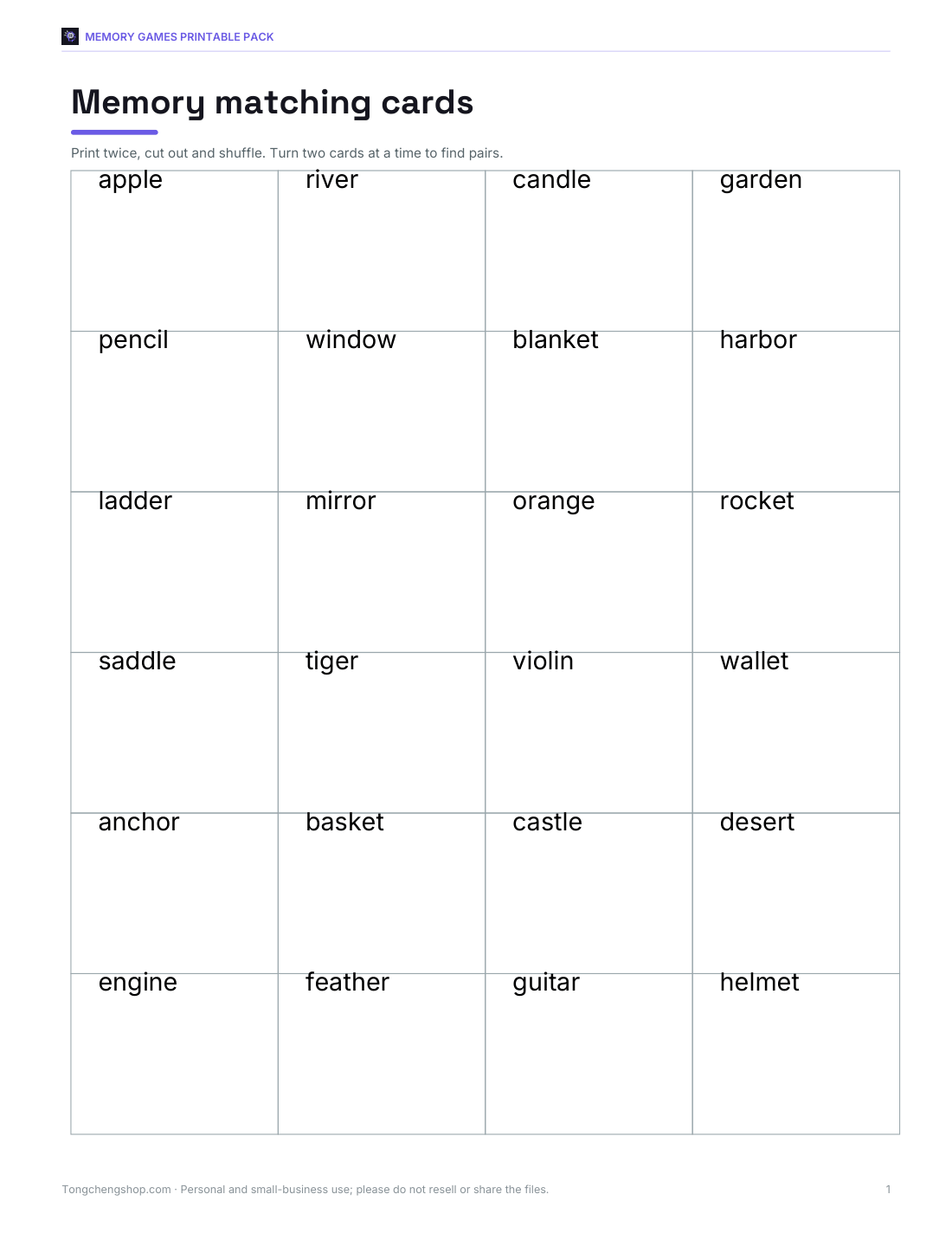
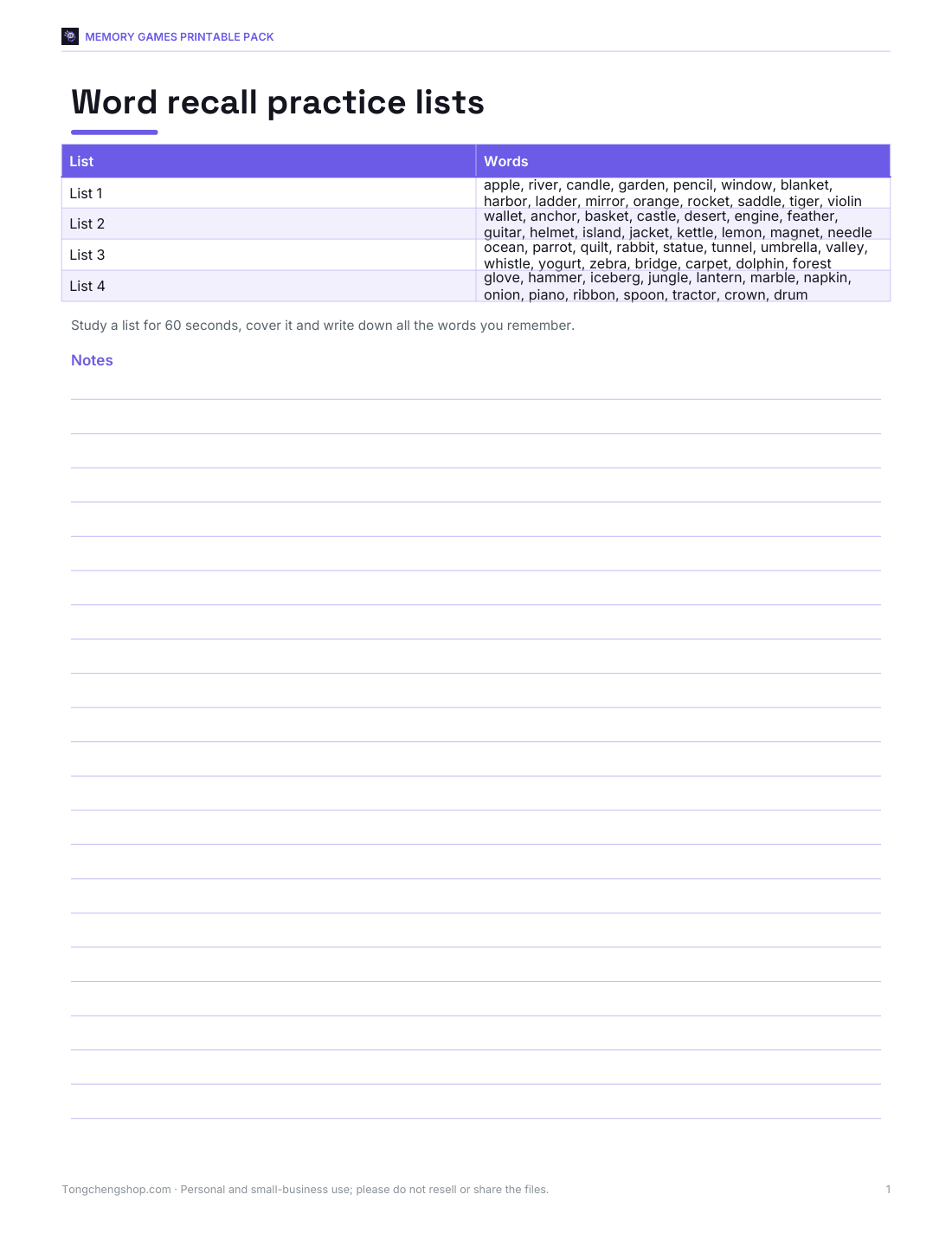
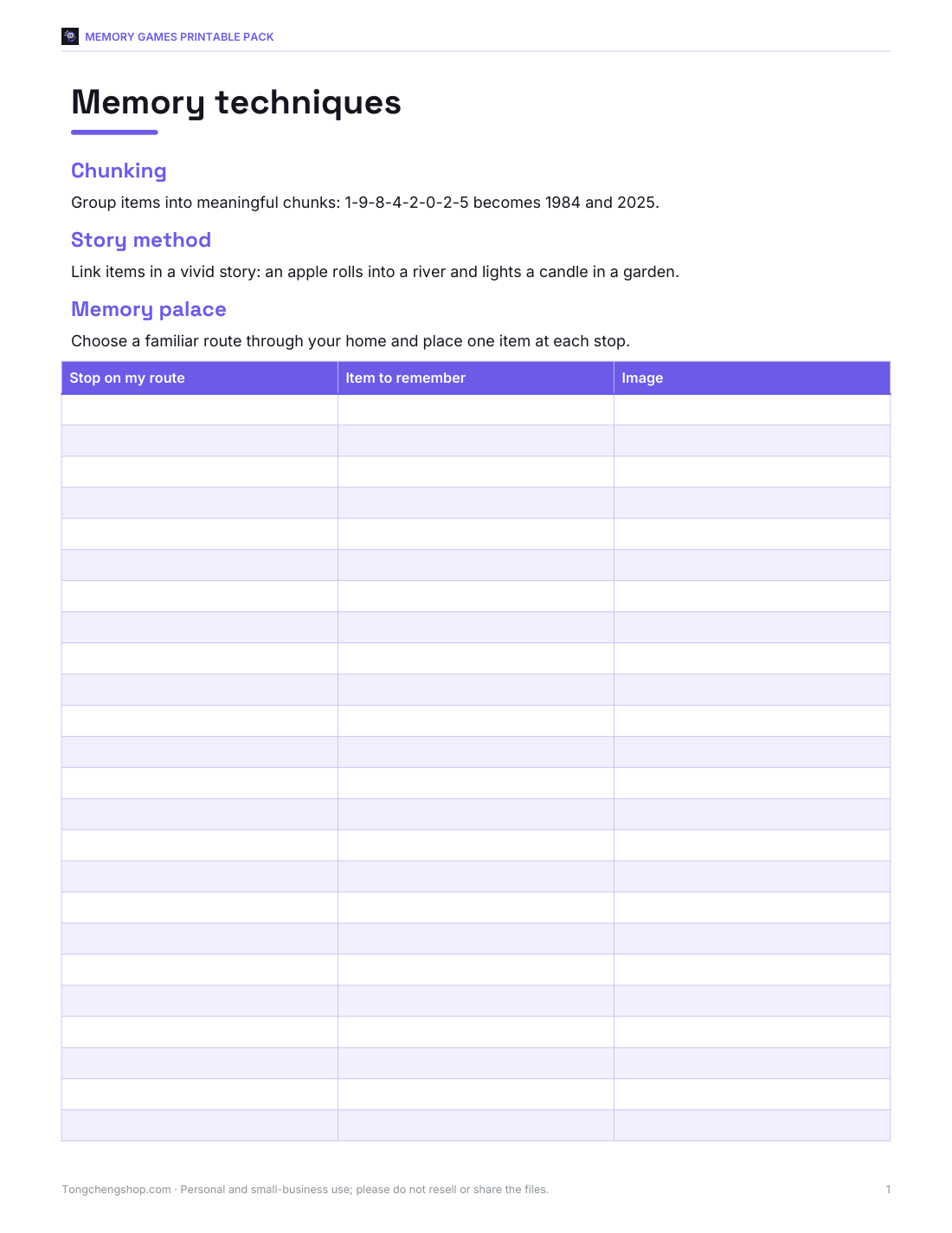
Printable memory matching cards, word recall lists with score sheets, a memory techniques guide with memory palace worksheets, a practice log spreadsheet and a weekly routine planner.
- Matching cards (PDF)
- Recall lists (PDF/XLSX)
- Techniques guide (PDF/DOCX)
- Practice log (XLSX)
- Routine planner (PDF/DOCX)
Formats: PDF, XLSX, DOCX. Instant download after payment (link valid 72 hours, up to 5 downloads). AI-assisted: the templates were drafted with AI help and reviewed and laid out before publishing.
$5.00 USD, one-time 5 files · about $1.00 each
- Instant download
- 7-day refund
- Secure checkout by Stripe
7-day money-back guarantee. Full refund within 7 days of purchase, even after you download.
Free sample: Memory Matching Cards (PDF, 55 KB)
Full refund within 7 days — see the refund policy and license.
Free printables
Single sheets you can print right now, no sign-up. The full pack adds every sheet in one download plus the editable files.
 Printable Memory Matching Cards
 Printable Memory Recall Lists
 Memory Techniques Printable Guide
 Printable Memory Practice Log
 Printable Weekly Memory Routine Planner
The three games
| Game | What it tests | How it works |
|---|---|---|
| Number span | Short-term (working) memory for sequences | Digits appear one at a time; type them back. Each correct answer adds a digit |
| Word recall | Remembering a list after a short study time | 15 everyday words for 60 seconds, then free recall in any order |
| Pattern memory | Visual–spatial memory | Squares light up briefly; tap the same squares. Three lives |
Your best score in each game is shown for the current session. Nothing is stored or uploaded.
What the scores mean
A classic finding in psychology is that people can hold about seven items, plus or minus two, in short-term memory — the digit span most adults reach is in that range, and grouping (“chunking”) digits into pairs or triples can push it higher. In free recall of a 15-word list, remembering around half is common on a first try, with words from the beginning and end of the list recalled best. Scores vary with sleep, stress, distraction and practice, so treat them as a fun snapshot rather than a measurement of ability.
This is not a medical test
These games are not designed or validated to detect memory problems, dementia or any other condition. If you or someone close to you notices memory changes that affect daily life — getting lost in familiar places, repeating questions, trouble managing money or medicines — talk to a doctor, who can arrange proper assessment.
Tips for remembering more
- Chunk numbers: 4-9-2-7-1-5 becomes 492-715.
- Make words into a story or a vivid picture that links them together.
- Use the method of loci: “place” each item along a familiar route in your home.
- Say items aloud or rehearse them silently.
- Get enough sleep — memory consolidation happens overnight.
- Reduce distractions while you learn something new.
Types of memory the games touch on
| Kind of memory | What it does | Everyday example |
|---|---|---|
| Working memory | Holds and manipulates information for seconds | Keeping a phone number in mind while dialling |
| Short-term verbal memory | Holds words and sounds briefly | Remembering a shopping list you just heard |
| Visual–spatial memory | Holds where things are | Recalling where you parked |
| Long-term memory | Stores information for days to decades | Knowing your childhood address |
The games mainly exercise the first three. Long-term memory depends more on meaning, repetition, sleep and emotion than on the raw span these games measure.
Using the games with groups
- Classrooms: run the word recall game on a projector and let students write answers, then discuss which strategies worked.
- Families: take turns at the pattern game and compare best scores across a week.
- Activity programmes for older adults: use the printable card games from the pack for relaxed, social practice rather than timed tests.
- Study groups: try the story method on key terms before an exam and compare recall.
- Keep the tone playful — the aim is enjoyment and trying techniques, not ranking people.
Why practice helps on these tasks
Scores on memory games usually improve with practice, mostly because people discover strategies — grouping digits, building images, rehearsing — and get used to the format. Research on “brain training” suggests that such gains tend to be specific to the practised task rather than improving memory in general, so it is best to think of these games as enjoyable exercise and a chance to learn techniques you can use in daily life, such as linking names to faces or turning a list into a story.
Worked example
A player starts the number span at three digits and answers correctly up to seven digits, then misses at eight, so the span shown is 7. In word recall they remember 9 of 15 words — mostly from the start and end of the list — and in pattern memory they reach eight squares before running out of lives. Trying again the next day after using chunking and a story method, their number span rises to 8 and word recall to 11.
What’s in the template pack
- Printable memory matching card game (picture-free word pairs for any age)
- Word lists for recall practice with scoring sheets
- Memory techniques guide: chunking, story method and memory palace worksheets
- Practice log spreadsheet to track scores over time
- Brain-friendly weekly routine planner
The pack is a one-time download for families, classrooms, activity coordinators and anyone who enjoys memory games.
Privacy
Everything runs in your browser. Scores disappear when you close the page.
Frequently asked questions
What is a normal digit span?
Many adults remember about 5 to 9 digits forwards.
Can this test diagnose memory problems?
No. It is a game, not a medical test — see a doctor if you are concerned.
Why do I remember the first and last words best?
These are known as the primacy and recency effects.
Can memory be improved with practice?
Practice and techniques such as chunking improve performance on these tasks.
Are my scores saved?
Only for this session in your browser.
Is the template pack a subscription?
No, it is a one-time download.
What is the best memory technique?
It depends on the material: chunking for numbers, stories or a memory palace for lists.
How long do the games take?
About one to three minutes each, depending on how far you get.
Why is the word list timed?
A fixed 60-second study time makes scores comparable from one try to the next.
Can children play?
Yes — the number and pattern games suit children who can read digits; the word game suits confident readers.